

Is NCSA worth it for volleyball? For some families, yes.
For most, no. NCSA college recruiting offers an athlete profile, a generated college list, and coach-outreach support.
Reported membership packages range from $250 to $2,100 per year for standard tiers, with premium tiers exceeding $3,000 per year. NCSA itself reports more than 40,000 college coaches use the platform and over 333,000 student athletes have committed to play their sport in college through it.
The daily phone calls and the gap between “exposure” and actual recruiting results, however, are why many parents call the investment a waste. For families willing to learn the recruiting process themselves, the same prep work — athletic scholarships research, coach emails, highlight video, target-school list — can be done free or with a one-time-purchase course at a small fraction of NCSA’s cost.
Disclosure: I have no affiliate relationship with NCSA and no financial interest in your buying decision either way.
I run a paid volleyball recruiting course (RecruitReady VB) and I’ll mention it once at the end. I’m not pretending this is a neutral review — but every claim about NCSA below is sourced or labeled as parent perspective.
You’ve gotten the calls.
So have I. NCSA — the Next College Student Athlete service — picks up most volleyball families somewhere around the end of 9th or start of 10th grade, usually after the athlete signs up for a free profile or fills out an online recruiting questionnaire that gets shared.
Then the phone starts. Three messages a week.
Four. Sometimes more.
The recruiter — sometimes called a “recruiting coach” inside NCSA — wants to talk about an athletic scholarship and the next steps in your recruitment journey. This is the post I wish I’d had then.
This review cites NCSA’s public pricing and reported user stats where possible. Reddit threads referenced are linked.
Where I’m sharing parent perspective (mine or other moms’) instead of cited data, I say so. NCSA is a great resource for some, a great tool for others, and not worth spending money on for many — context matters, and this post tries to give you that context. The bigger picture for getting recruited — without spending anything — is covered in our pillar guide to how to get recruited for volleyball.
Key Takeaways
- NCSA membership packages cost $250–$3,000+ per year, with premium tiers exceeding $3,000. The core deliverables — athlete profile, college list, coach-outreach workflow — can be replicated for free or with a one-time-purchase course at a small fraction of the annual cost.
- The daily phone calls and renewal pressure are the most-reported frustrations among NCSA customers across Reddit, Trustpilot, and parent forums. Many families call the investment a waste, especially for D1 prospects who get recruited primarily through direct outreach and club tournaments.
- NCSA can be worth it for time-poor families targeting D2, D3, NAIA, or JUCO who don’t have an existing athletic network and are willing to manage the sales-call cadence. For most volleyball families, the same prep work is more cost-effectively done independently.
- Whatever you decide, the actual recruiting work is the same. Coach emails, NCAA Eligibility Center registration, a strong highlight video, and a realistic target list aren’t gated behind any service — they’re things you do either way.
What NCSA Actually Does
NCSA (Next College Student Athlete, owned by IMG Academy / Endeavor) is a college recruiting service that operates across every major sport — football, baseball, volleyball, basketball, soccer, softball, and more. In its paid tiers, NCSA helps families build a free athlete profile, generates a list of potentially-matched schools, and supports outreach to college coaches. Families sign up either through the NCSA website directly or through one of its many partner channels (state high school associations, tournament events, online questionnaires).
According to the NCSA website, over 40,000 college coaches use NCSA to reach their recruiting goals, demonstrating the platform’s widespread acceptance among coaches across most sports. NCSA also claims that in 2024, college coaches conducted more than 1 million searches using the NCSA platform, and that the company has helped more than 333,000 student athletes commit to play their sport in college.
These are NCSA-reported numbers from its marketing materials. The company does not publish what percentage of the underlying user base those 333,000 commits represent (which is the number that would tell you the base rate of success).
The NCSA recruiting process begins with creating a free athlete profile, which makes the athlete searchable to over 40,000 college coaches. The service then runs on a sales-driven model: the free profile signs you up; a recruiter calls; a paid tier is recommended based on your son’s or daughter’s perceived level.
That’s how the company makes money — paid memberships, often with multi-year commitments.
How Much NCSA Costs in 2026
This section reflects NCSA’s reported pricing as of June 2026. Verify against the NCSA website before making a decision — pricing changes regularly.
NCSA does not list paid-tier pricing publicly on the NCSA website, which is the first signal: pricing is negotiated by phone.
Based on Reddit threads, YouTube reviews of the service, and parent reports collected by recruiting forums:
| Tier | Typical reported price | What it unlocks |
|---|---|---|
| Free profile | $0 | The free part: basic athlete profile, limited “scout” alerts, regular sales-team outreach by phone |
| Standard membership | ~$250–$2,100 per year | Hosted athlete profile, college list, coach-outreach email tools, dashboard, video upload |
| Premium membership | $3,000+ per year (some users report) | Standard features plus more dedicated phone time with a recruiter, additional outreach support |
| Multi-year package | Discounted from above | Locks in services for two or three years; common upsell |
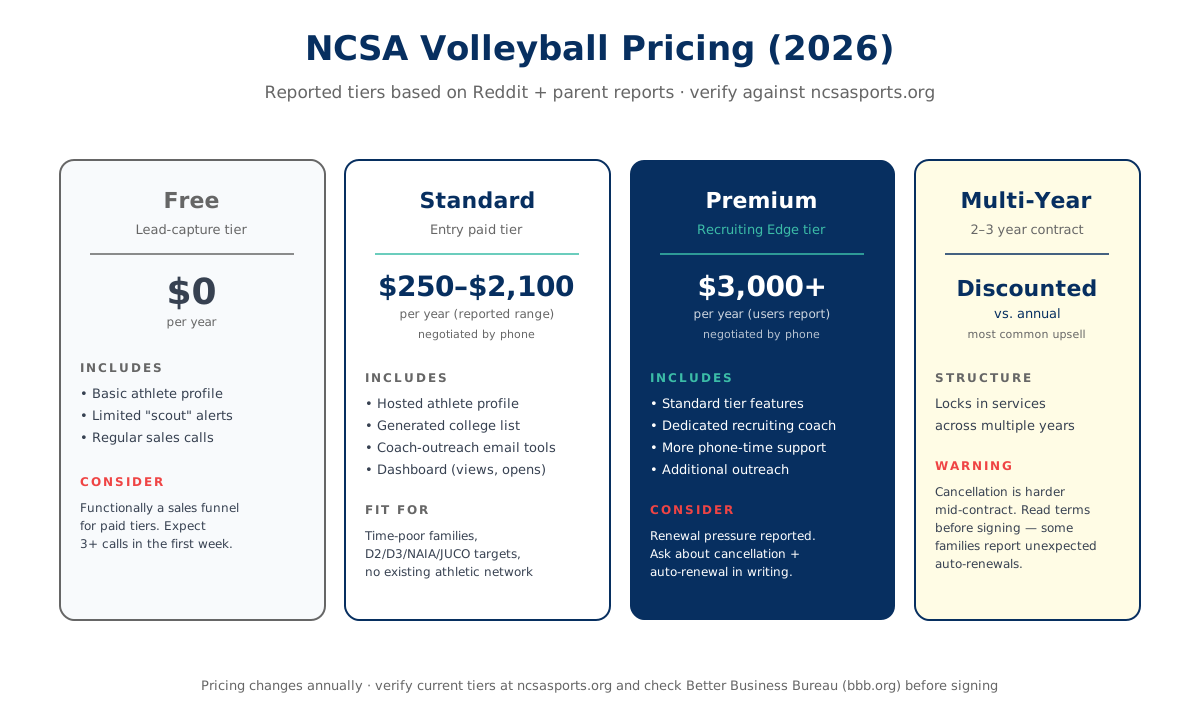
NCSA offers different membership packages that can range from $250 to $2,100 depending on the level of service chosen. While NCSA provides a free membership option, many users report that the paid memberships, which can exceed $3,000, may not provide sufficient value for the investment.
The free part of NCSA exists primarily to feed paid-tier sales. The hosted athlete profile, college list previews, and most useful tools sit behind the paywall. Renewal pricing typically matches or exceeds the original — there isn’t a meaningful loyalty discount, and renewal calls begin weeks before the renewal date.
For context on volleyball-specific value: annual NCAA Division I women’s volleyball roster spots across all 340-ish programs total roughly 4,000–5,000 (with about a quarter of those open in any given year). The math on “exposure” — paying for visibility to over 40,000 college coaches when the relevant volleyball-specific subset is a small fraction of that — is worth understanding before spending money on a paid tier.
What You Actually Get For the Money
The four real deliverables in NCSA’s paid tier:
- The athlete profile. A hosted page with measurables (height, standing reach, approach touch, block touch), highlight video link, club team, GPA, and tournament schedule.Useful, but a free Google Doc or a simple personal page does the same thing.
- The college list. A generated list of programs roughly matched to the athlete’s level and academic profile. The list is broader than most families would build themselves — which is either a feature (you discover schools you wouldn’t have) or a bug (the list is generic, the same as every athlete with similar measurables).
- Coach-outreach tools. Email templates, a contact database, and a workflow for sending messages to college coaches.The tools are reasonable. The question is whether they’re $2,000–$6,000 better than a Google Sheet.
- The dashboard. Tracking of profile views, email opens, and coach interactions. This is the most-marketed feature and the least useful — coach views are not the same as recruiting interest, and the dashboard creates a sense of activity that doesn’t always translate to roster offers.
The Honest Pros
To be fair, NCSA does some things well, and there are families it genuinely fits.
For families with no time. If both parents work long hours, there are younger siblings in the house, and the athlete is a freshman or sophomore who needs scaffolding to get started — NCSA does take some of the getting started friction off the family. You pay for that scaffolding, but it exists.
For families with no athletic network. If your daughter is the first in your family to consider college athletics and you don’t know any club coaches, college coaches, or other recruited families — NCSA’s college list and outreach templates do give you a starting framework. You’d build the same thing yourself eventually; NCSA shortcuts the first few weeks.
For first-generation college families. NCSA’s broader college list and academic-eligibility prompts can be useful for families who didn’t go through their own U.S. college admissions process. The eligibility center walkthroughs and core-course tracking are reasonable.
For non-D1 targets specifically. The “exposure” pitch works least well for D1 prospects (who are already on coaches’ radar through club competition) and somewhat better for D2, D3, NAIA, and JUCO targets, where program-by-program outreach matters more and coaches do scan submitted profiles.
The Honest Cons

Now the harder part, with sources.
The daily phone calls and messages. This is the single most-reported frustration. Reddit threads in r/CollegeRecruiting, YouTube reviews of NCSA, and parent posts on volleyball forums routinely describe receiving multiple phone calls and text messages per week — sometimes daily — from an NCSA recruiter or “recruiting coach” both before and after signup. Source: parent reports, multiple Reddit threads, YouTube — search “NCSA review” or “is NCSA worth it” for current first-hand video accounts from parents who actually used the service. Some parents report 10+ calls in the first two weeks after creating a free profile.
“Exposure” vs. results. NCSA markets exposure as the primary value — and yes, over 40,000 college coaches do use the platform. The harder question is whether that exposure translates to roster spots for your athlete.
The honest answer based on parent reports and what I’ve heard from D1 and D2 coaches: most coaches receive far more athlete profiles than they can review, NCSA-sourced or otherwise. Coaches do scan profiles, especially at the D2, D3, NAIA, and JUCO levels.
They also receive direct emails from athletes for free. The marginal benefit of an NCSA-hosted profile over a personal-page-plus-direct-email approach is not as large as the pricing suggests.
NCSA’s reported 333,000 commits over the company’s history sounds impressive until you compare it to the millions of athletes who’ve created free profiles — the base rate of “NCSA user gets signed” is much closer to the base rate of “high school athlete gets signed” than NCSA’s marketing implies. Some parents call the paid investment a waste; others get fair value. Context matters.
Renewal pressure. Multi-year contracts and aggressive renewal calls are commonly reported. Some families report difficulty cancelling their account, multiple charges on file, or auto-renewals they didn’t expect. Source: Better Business Bureau complaint history at bbb.org (search “NCSA Sports”) and Trustpilot reviews — read the recent ones before committing to a multi-year package.
One-size-fits-all college lists. The generated college list is often too broad and not tailored to the athlete’s specific preferences (region, school size, intended major, fit). Most families end up rebuilding the list themselves — the most valuable filter on a target school list is usually “does she want to live there” not “does her vertical match the roster average,” and that’s not something an algorithm produces. The advice from coaches and from parents who’ve finished the journey is consistent: focus your time and attention on programs you’d actually want to commit to, not a long algorithm-generated list.
Who NCSA Is Right For — and Who It Isn’t
Putting both sides together, here’s the honest read:
NCSA might be worth it if: you’re truly time-poor, you have no athletic or college network to lean on, the athlete is a freshman or sophomore with strong measurables but no D1 visibility yet, you’re targeting D2 / D3 / NAIA / JUCO where profile-based outreach matters, and you’re willing to push back firmly on upsell and renewal calls.
NCSA is probably not worth it if: you have a few hours a week to learn the system, your athlete has a club coach who already advocates for her, you’re targeting D1 specifically (your club exposure and direct coach emails do more), or you’re price-sensitive — the $1,500–$6,000 spend often covers a year of club fees, camps, or campus visits that would have higher direct impact.
The Alternative: Doing It Yourself
The recruitment work NCSA does for you isn’t a secret. It’s a handful of moving parts that any motivated parent and athlete can learn — same process, no recurring fee, no sales calls.
- Build a target school list — 20 to 40 programs across D1, D2, D3, NAIA, and JUCO, filtered by major, region, school size, and program fit.Time: 4–8 hours initially, then ongoing.
- Create an athlete profile — height, standing reach, approach touch, block touch, GPA, test scores, club, jersey number, highlight video link, contact email. Time: 1–2 hours. (We have a printable template in our free 7-day plan.)
- Make a 3–5 minute highlight video — phone, tripod, club season footage, upload to YouTube.Time: 4–8 hours including editing.
- Email college coaches directly — personalized, athlete-led emails. Once a month during season.Time: ~2 hours a week sustained. (Our deep dive on how to email college coaches yourself walks through templates.)
- Register with the NCAA Eligibility Center by end of 10th grade. Time: 1–2 hours plus document submission.
- Track everything in a spreadsheet — school, division, head coach, email, date contacted, response, follow-ups.Time: 30 minutes a week.
That entire workflow, done by the athlete with parent support, costs $0 in services and roughly 3–4 hours a week of focused work during peak season. It’s also the workflow every D1, D2, and D3 coach I’ve talked to says they prefer — they want emails from the athlete, not from a service.
There’s free advice on YouTube, free templates from former college coaches, and free guides from the NCAA itself. The core resources are all out there if you have the patience to find and follow them.
📥 Want the printable starting plan? Our free 7-Day Volleyball Recruiting Jumpstart is the one-page-per-day DIY starter — coach list, video draft, NCAA Eligibility Center, first email.
No upsell calls. Tape it on the fridge.
NCSA vs RecruitReady VB vs DIY: Comparison Table
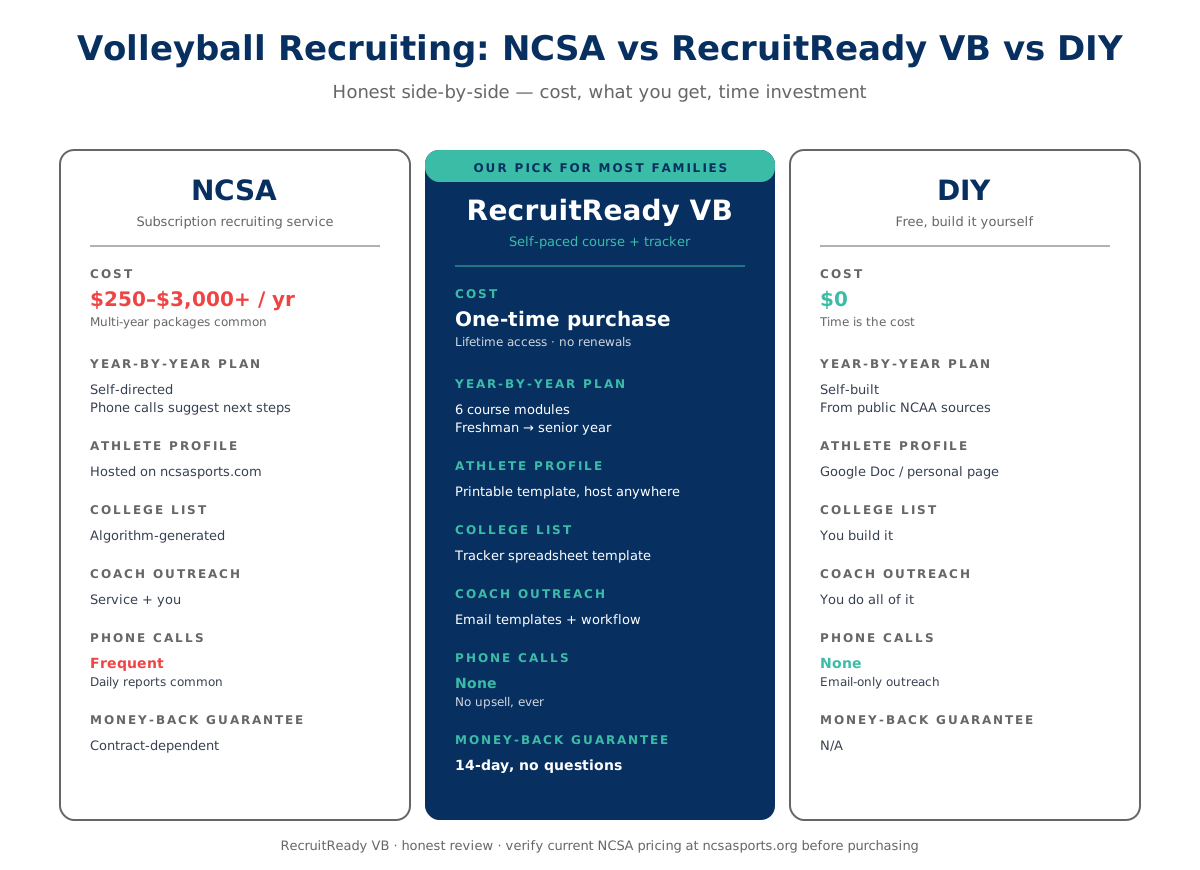
| Feature | NCSA | RecruitReady VB | DIY (Free) |
|---|---|---|---|
| Cost | ~$1,500–$6,000 per year | a one-time purchase with lifetime access | $0 |
| Year-by-year plan | Self-directed; phone calls suggest next steps | 6 course modules covering freshman → senior year | Self-built |
| Athlete profile | Hosted on ncsasports.com | Printable template, host anywhere | DIY |
| College list | Algorithm-generated + suggested | Tracker spreadsheet template, you build the list | DIY |
| Coach outreach | Service does + you do | Email templates + workflow. You send | You do |
| Highlight video help | Upload + storage | Shot list, title-card template, position-specific reels | DIY |
| Phone calls to your family | Frequent (daily reported by some) | None | None |
| NCAA Eligibility Center walkthrough | Yes (basic) | Yes (printable step-by-step) | NCAA’s own site |
| Renewal pressure | Reported | None — one-time purchase | None |
| Money-back guarantee | Varies / contract-dependent | 14-day, no questions | N/A |
The honest read: NCSA, RecruitReady VB, and DIY all can get a motivated athlete to a college roster.
The difference is the trade between money, time, and pressure. NCSA buys you scaffolding plus calls; RecruitReady VB buys you a year-by-year plan with no calls; DIY costs only time.
Pick the one that matches what you actually have.
What I’d Actually Do If I Were Starting Over
And before any of that, build the recruiting timeline by grade — our volleyball recruiting calendar guide walks through every key date from freshman year through senior signing day.
Honestly? I’d start with the DIY workflow because I’d want my daughter learning the recruiting process herself, not having someone do it around her.
Coaches across every division I’ve talked to say the same thing: they’re recruiting the athlete, and one of the things they’re recruiting for is how she runs her own journey. An athlete who can write her own coach email and sit down with her parents to focus on a short list of target schools is a different recruit than one whose service writes the emails for her.
That said, I also wanted a roadmap I didn’t have to invent from scratch — the year-by-year prompts, the printable checklists, the email templates, the eligibility tracker. So I built RecruitReady VB after we’d been through the process.
It’s the system I would have paid one-time purchase for in 9th grade to skip the trial-and-error. Friends in our club have used it; parents whose son or daughter is in a different sport have asked whether to invest in a service or stick with the DIY route. My standard advice: stick with DIY first, add a paid course or workbook if you want structure, and skip the recurring-fee services unless your situation specifically warrants it.
If you’re at NCSA-call frequency right now, take a breath. You have time.
The recruitment journey rewards organized over expensive.
Frequently Asked Questions
Is NCSA worth $5,000 for volleyball?
For most families, no. The core deliverables — an athlete profile, a college list, a coach-outreach workflow — can be built independently for free, or with a one-time-purchase course at a small fraction of NCSA’s annual cost.
NCSA may be worth it for time-poor families without an existing athletic network who are targeting D2, D3, NAIA, or JUCO programs and are willing to manage the renewal-call pressure.
Can you cancel NCSA at any time?
NCSA contracts vary. Single-year subscriptions can typically be canceled at renewal, but multi-year packages have stricter terms.
Some families report difficulty canceling mid-contract or unexpected auto-renewals. Read the contract carefully before signing, ask explicitly about cancellation, and keep written records of every conversation.
For current customer experiences, search Better Business Bureau complaints and recent Trustpilot reviews.
How does NCSA compare to FieldLevel or SportsRecruits?
NCSA is the largest U.S. recruiting service by user base. FieldLevel is more coach-network-driven (the platform’s value is the coach side as much as the athlete side).
SportsRecruits is closer to NCSA in model but with different pricing. None of the three are necessary to get recruited — most college coaches recruit primarily through direct outreach, club tournaments, and personal emails regardless of which platform an athlete uses.
What are the alternatives to NCSA for volleyball recruiting?
Three main alternatives: (1) doing it yourself for free — coach emails, NCAA Eligibility Center registration, target school spreadsheet, highlight video; (2) a one-time-purchase course or workbook that teaches the recruiting process without ongoing fees (we built RecruitReady VB for this — lifetime); (3) a private recruiting consultant — typically a former college coach paid hourly, much higher per-hour cost but more personalized than NCSA.
Do college volleyball coaches actually look at NCSA profiles?
Some do, especially at the D2, D3, NAIA, and JUCO levels where program-by-program profile outreach matters more.
D1 coaches generally rely on club competition, direct athlete emails, and their own networks more than service-hosted profiles. Either way, having an NCSA profile is not a substitute for athlete-direct outreach — the strongest recruiting signal is a personalized email from the athlete to the coach, not a hosted profile.
Is the NCSA free version enough?
The free version is functionally a lead capture for the paid tier.
You get a basic profile, very limited college-list previews, and regular calls from NCSA recruiting coaches. The free tier doesn’t deliver enough on its own to meaningfully change a recruiting outcome — most families either upgrade to a paid tier (if they’re going to use the service) or skip NCSA entirely and run a DIY workflow.
Final Word
NCSA is a real service with real customers. It’s also a service that costs $1,500–$6,000 a year, makes its money on sales-driven phone outreach, and delivers a workflow that a motivated family can replicate for free.
The decision isn’t “is NCSA a good service” — for some families it is. The decision is “is NCSA the best use of $1,500–$6,000 in our recruiting budget?” For most families I’ve talked to, the honest answer is no — that money is more often better spent on club fees, camps at programs that are actually on the target list, official-visit travel, or simply saved for tuition.
Start with the free plan
the DIY starter that walks through the first week of recruiting work, one page per day. No upsell calls.
Download the printable 7-Day Volleyball Recruiting Jumpstart →
P.S. — If you want the full year-by-year recruiting roadmap with 58 printable guides, coach email templates, and the recruiting tracker spreadsheet, the full system is a one-time purchase with lifetime access and a 14-day money-back guarantee. One-time purchase, no renewal calls.
This review reflects NCSA’s pricing and customer experience reports as of June 2026. Always verify current pricing at ncsasports.org and check recent customer reviews at Better Business Bureau and Trustpilot before making a purchase decision. Pricing, contract terms, and service offerings change. Nothing here is legal or compliance advice.