

Getting recruited to play college volleyball means earning a roster spot at any of the five collegiate levels — NCAA Division I, II, or III, NAIA, or junior colleges (JUCO) — through a combination of volleyball skills, academic eligibility, and proactive communication with college volleyball coaches.
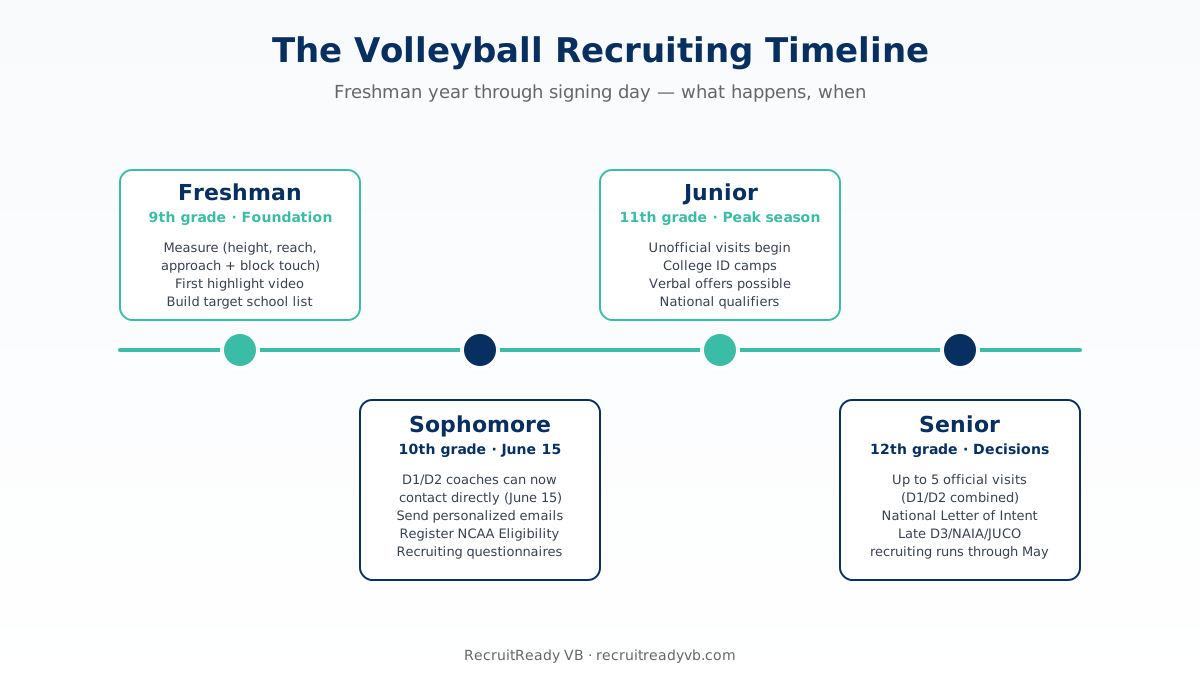
For most female high school volleyball players the volleyball recruiting process starts in 9th or 10th grade, and for male athletes a year later. It ends with a verbal offer, a verbal commit, or a National Letter of Intent in the senior year.
I’m writing this from the bleachers, basically. My daughter is a current high-school club player, and we are deep in the middle of this whole process right now — not finished, not retrospective, not coaching anyone else’s kid from the other side.
Just figuring it out the way you probably are: a little late to it, a little behind the mom one row down who’s already on the phone with a college coach between sets, a little tired of Google sending us in circles. If that sounds like your weekend, you’re in the right place — this is the guide I wish someone had handed me a year ago when we walked into our first big qualifier and realized we had no idea what was supposed to be happening.
Key Takeaways
- College volleyball coaches start seriously tracking prospects in 9th–10th grade for girls and 10th–11th grade for boys. If your daughter is older than that, you are not behind — you’re on time on a tighter recruiting timeline.
- The fastest way to get noticed is the combination of four things: playing club volleyball at the highest level you can reasonably make, a sharp 3–5 minute highlight video, completed recruiting questionnaires on every target program’s site, and consistent personalized emails to college volleyball coaches. No single one of those does it alone.
- Good grades open more doors than most families realize. A strong GPA and solid test scores make your athlete recruitable across more divisions and unlock academic scholarships and need-based financial aid that often beat the athletic scholarship in raw dollars.
- Build a realistic list of potential schools across all five divisions — D1, D2, D3, NAIA, and JUCO — based on the athlete’s height, standing reach, measurables, current skill level, and academic fit. The families who only target D1 are usually the ones still unsigned in May of senior year.
Introduction: What It Really Takes to Get Recruited for Volleyball
There are roughly 475,000 high school volleyball players (girls) in the U.S., and only about 7,000 women’s college volleyball roster spots across all divisions combined (NCAA participation data).
For boys it’s even tighter — about 1,500 men’s college volleyball roster spots at all five levels. So yes — competition for a roster spot is real, and no, your daughter is not paranoid that everyone else seems to be talking to college coaches already.
But here’s the part nobody mentions in those scary stat cards: a huge portion of those high school volleyball players aren’t actually trying to get recruited. They never email a coach, never make a highlight video, never fill out a recruiting questionnaire.
Of the families who do all the basic, unglamorous work, a meaningful percentage of student-athletes end up on a college roster somewhere across the five different divisions. Not always at the school they first dreamed of — but somewhere.
This article walks you through the full college volleyball recruiting journey, in order: the landscape, talent and academic evaluation, the NCAA divisions, building a list of potential schools, club volleyball and exposure events, the highlight video, contacting college coaches, academic eligibility, athletic scholarships, and campus visits. It’s long — skim what you’ve already nailed; live in the sections where you feel lost.
One promise upfront: nowhere in this guide am I going to tell you to spend $5,000 on a recruiting service. For most of us they’re an expensive shortcut around work we needed to do anyway.
Understand the College Volleyball Recruiting Landscape
College volleyball recruiting is the recruitment process by which college volleyball coaches identify, evaluate, and ultimately sign high school volleyball players and club athletes to their rosters.
It happens through club tournaments, highlight videos, streaming platforms, recruiting questionnaires, recruiting services, and — most underrated — direct, personalized emails from the athlete. Here’s a 2025–2026 snapshot of the landscape:
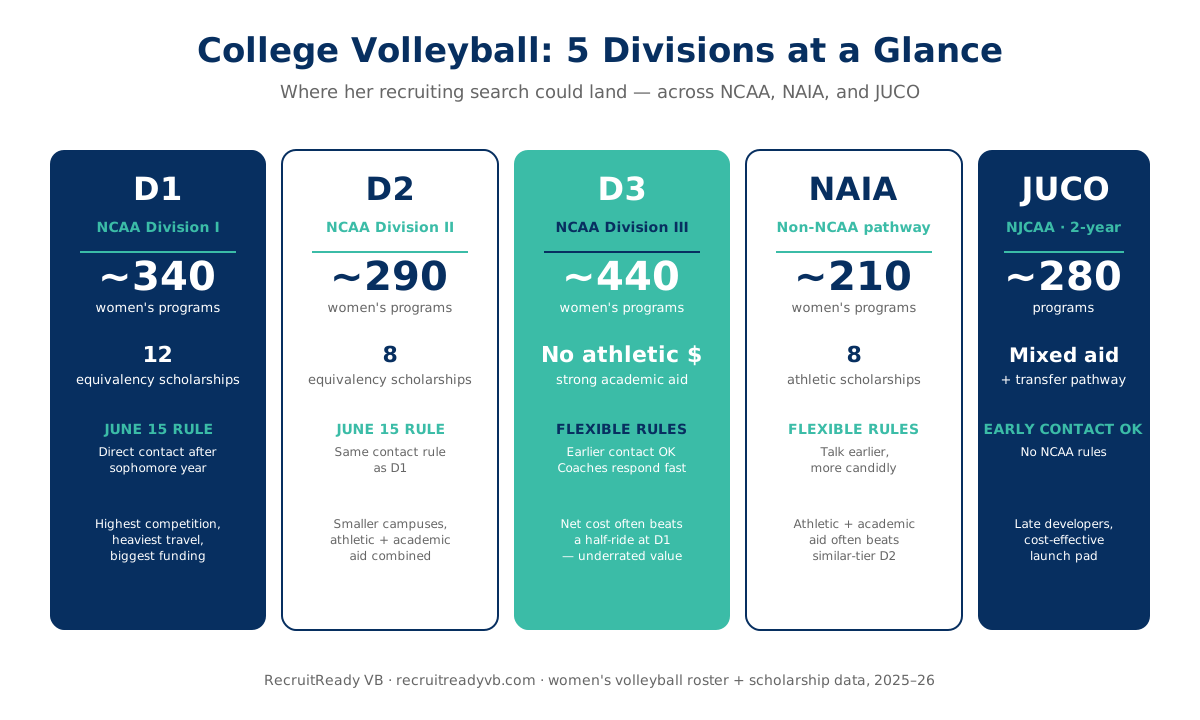
A few things worth understanding: women’s volleyball is an equivalency sport, so a coach with 12 scholarships almost never gives 12 full rides — they slice the money into half-rides, quarter-rides, and books-only offers. Men’s volleyball has far fewer programs (~150 across NCAA and NAIA combined) and a different recruiting calendar. The math is tighter but the principles in this guide all still apply.
And not all programs are fully funded even within the same division — a D1 mid-major might only have 6 of 12 scholarships funded by the school. Walk-on spots exist at most levels too, with no athletic scholarship but a real roster spot.
How do most coaches actually find players in 2026? Six main channels: club tournaments (especially big multi-court qualifiers), streaming platforms like Hudl and BallerTV, recruiting video links emailed directly, online recruiting questionnaires filled out on each program’s site, verified recruiting services, and direct outreach from the athlete.
We’re going to spend most of this guide on that last one because it’s the one you control.
📥 Free download: I made a printable 7-Day Volleyball Recruiting Jumpstart that walks through the first week of action — coach list, video draft, first email. Tape it on the fridge.
Honestly Evaluate Your Talent Level and Academic Profile
This is the step most families skip, and it’s the step that determines whether everything you do after is wasted effort. Before you send a single email, college volleyball players (and their parents) need a clear-eyed read on three things: where the athlete realistically projects athletically, where she fits academically, and which different divisions actually match. Skipping this talent evaluation and mass-emailing twelve D1 head coaches is how families burn an entire fall before realizing nobody is writing back for a reason.
Concrete volleyball benchmarks to know. These vary by position, but for outside and right-side hitters — height, standing reach, approach touch, and block touch are the numbers college volleyball coaches will ask about first:
- D1 recruit zone: 6’0″+, ~7’9″+ standing reach, 9’10″+ approach touch, 9’4″+ block touch, elite club team
- D2 recruit zone: 5’10″+, ~7’6″+ standing reach, 9’6″+ approach touch, 9’0″+ block touch, top regional club
- D3 / NAIA recruit zone: 5’9″+, ~7’5″+ standing reach, 9’3″+ approach touch, often academic standout
- JUCO recruit zone: wide range — where late developers and athletes with academic work to do find their footing
Defensive specialists, liberos, and setters get evaluated on a different rubric (passing percentages, decision-making, leadership). These numbers aren’t gospel — every class has the kid who under-measures and over-performs — but they’re a starting orientation. Get an honest read from your high school and club coaches too: ask “Where do you realistically see her playing — D1, D2, D3, NAIA, or JUCO?” Most won’t volunteer it. They will if you ask directly.
The academic side matters as much as the athletic side. Good grades and strong test scores unlock more opportunities across every level. Thresholds worth memorizing for academic eligibility and financial aid:
- 2.3 minimum NCAA core GPA for D1 academic eligibility (sliding scale with test scores)
- 3.0+ opens significant academic aid and academic scholarships at D2, D3, NAIA, and JUCO levels
- 3.5+ is where money stacks — academic merit aid at D3 schools can outperform athletic scholarships at lower-funded D1/D2 programs
Families fixate on the athletic scholarship number and miss that for many academic over-performers, the D3 academic merit package is the better deal. (NCAA Eligibility Center has the official GPA/test score sliding scale.)
Learn the NCAA Divisions and Types of College Volleyball Programs
Most families assume “college volleyball” means D1 because that’s what’s on TV.
Understanding the actual five-level landscape is what lets you build a list that has a chance.
NCAA Division I, II, and III
NCAA Division I is the highest competition level — 20+ hours per week in season, heavy travel, grueling schedule, biggest funding. About 340 women’s D1 programs, up to 12 equivalency scholarships per team (most not fully funded). D1 coaches can’t have direct off-campus contact with a recruit until June 15 after sophomore year, but you can email them anytime and fill out their online recruiting questionnaire at any age.
NCAA Division II is still extremely competitive — many D2 programs would beat lower-end D1s on a given day — but campuses are smaller, school-life balance is more reasonable, and the aid package is often a mix of athletic scholarships and academic aid. D2 has the same June 15 rule as D1.
NCAA Division III is the most misunderstood division on the list. D3 schools cannot offer athletic scholarships at all — but they’re often the most academically generous, and the need-based aid plus academic merit aid for a strong student-athlete can rival a half-ride at a D1.
Volleyball is still serious; practice hours are slightly fewer; D3 has more flexible contact rules, so college coaches at this level can respond to your daughter’s emails earlier. For strong student-athletes with middle-of-the-rubric measurables, D3 is the most underrated value play in the entire landscape.
Pull up a few current rosters at schools you’re considering — average height, position distribution, and which club teams players came from is the most honest mirror of whether your athlete fits.
NAIA and Junior Colleges (JUCO)
NAIA volleyball is a strong, flexible alternative that doesn’t get talked about enough — roughly 210 women’s programs, up to 8 athletic scholarships per team, relaxed recruiting rules, relationship-driven culture. NAIA coaches can talk to your daughter sooner, more often, and more candidly. Many NAIA programs combine athletic scholarships and academic aid into packages that beat what a similar-tier D2 program would offer.
Junior college (JUCO) volleyball is a two-year pathway through NJCAA programs. Volleyball players develop, compete at a high level (the top NJCAA national tournament is genuinely good volleyball), and then transfer up to NCAA or NAIA four-year schools after one or two years.
JUCO programs are ideal for late developers, athletes who need academic work to qualify for NCAA, or athletes who want a cost-effective starting point before transferring. Junior college coaches typically have far more flexibility to communicate with recruits early than D1 or D2 staffs.
A reframe that’s helped us: NAIA and JUCO are not “backup plans.” They’re legitimate primary plans for a lot of athletes, and families who treat them that way end up with better outcomes. When researching any program — especially JUCO — look at graduation rates and transfer rates, not just volleyball performance.
Build a Smart List of Target College Programs
Once you understand the landscape, build a list of potential schools.
Start broad: 20 to 40 college programs across multiple NCAA divisions plus NAIA and JUCO. You’ll narrow it dramatically over the next year — most families end senior year actively communicating with 8–12 college volleyball programs — but starting narrow means starting wrong.
Key filters as you build the initial list:
- Desired major — the single best narrowing filter and the one families underuse
- Geographic region and school size — drive time matters; a 1,500-student LAC vs. a 35,000-student state school is a different experience
- Cost and aid posture — sticker price tells you less than the net price calculator
- Level of competition — be honest about reach / match / safety mix
- Likely freshman playing time — look at the roster; six 2027 setters returning is information
Organize in a spreadsheet (school, NCAA division, head coach, assistant coach, email, date first contacted, recruiting questionnaire submitted, follow-up sent, camp invite, campus visit, scholarship offer, status). I built one for our family that lives in our course as the Recruiting Tracker, but a plain Google Sheet works fine. Insider tip: for each school, watch a half match on the team’s stream — you’re not scouting opponents, you’re scouting whether the system suits your athlete.
A team that runs a 6-2 has different needs than a team that runs a 5-1.
Play Club Volleyball and Seek the Right Events for Exposure

In 2026, club volleyball is where the vast majority of college volleyball recruiting actually happens.
In 2026, club volleyball is where the vast majority of college volleyball recruiting actually happens. College coaches show up to volleyball tournaments because they can see 200 prospects across a weekend without leaving a convention center in Dallas or Chicago.
Play at the highest club volleyball level your daughter can reasonably make. Even if it means more travel and tougher position competition, she faces stronger competition (which makes her better) and she plays at the events college coaches actually attend. A club that never makes it to qualifiers is invisible regardless of how good your daughter looks at local Saturday tournaments.
The exposure events that matter most:
- National qualifiers (January through May) — these are the big ones. Coaches stack their schedules around them.
- National championships — only your team gets there, but if you do, college coaches are everywhere
- Showcases and combines — usually $100–$400 to enter, mix of skills evaluation and game play
- College ID camps — narrower (one or two schools per camp), but the highest-quality face time with that coaching staff specifically
Before any volleyball tournament with college coaches present, email your target list. A short note: jersey number, court assignment, match schedule, your daughter’s name and grad year, and a link to the recruiting video.
If a coach has any interest at all, they need to be told where to look.
Choosing the Right Tournaments, Camps, and Showcases
Tournament fees + travel + camps can easily run $10K–$15K a year if you’re not deliberate. Prioritize events that historically draw coaches from your target divisions — ask your club for their coach lists. Differentiate exposure events from skill-development camps: a 32-coach showcase is exposure; a single-school elite camp is targeted skill work and relationship-building. Both have value; don’t confuse one for the other.
Don’t overspend on mass camp invites — they’re a marketing channel and only worth it when the school is genuinely on your list. Always send a follow-up email after a camp or tournament where you interacted with a coaching staff — two to four sentences, thank them, send updated video, ask one specific question. And match event choices to the school year — don’t drag a junior to four out-of-state tournaments during her toughest academic semester; recruiting suffers when grades suffer.
Create a Standout Volleyball Highlight Video
For most college volleyball coaches in 2026, the highlight video (or recruiting video) is the first time they see your daughter play. They watch it on a phone in an airport between flights to qualifiers — first 20 seconds, then they decide to keep watching or close the tab.
What works:
- 3 to 5 minutes total length — anything longer is unwatched
- Strongest plays in the first 20–30 seconds — that window is the decision window
- Clips labeled by position and jersey number — tell them where to look
- Two videos: a position-specific volleyball skills reel (serve, pass, set, attack, block, dig) AND a full-match-touches video showing her in flow
- Update every 3–4 months during club season
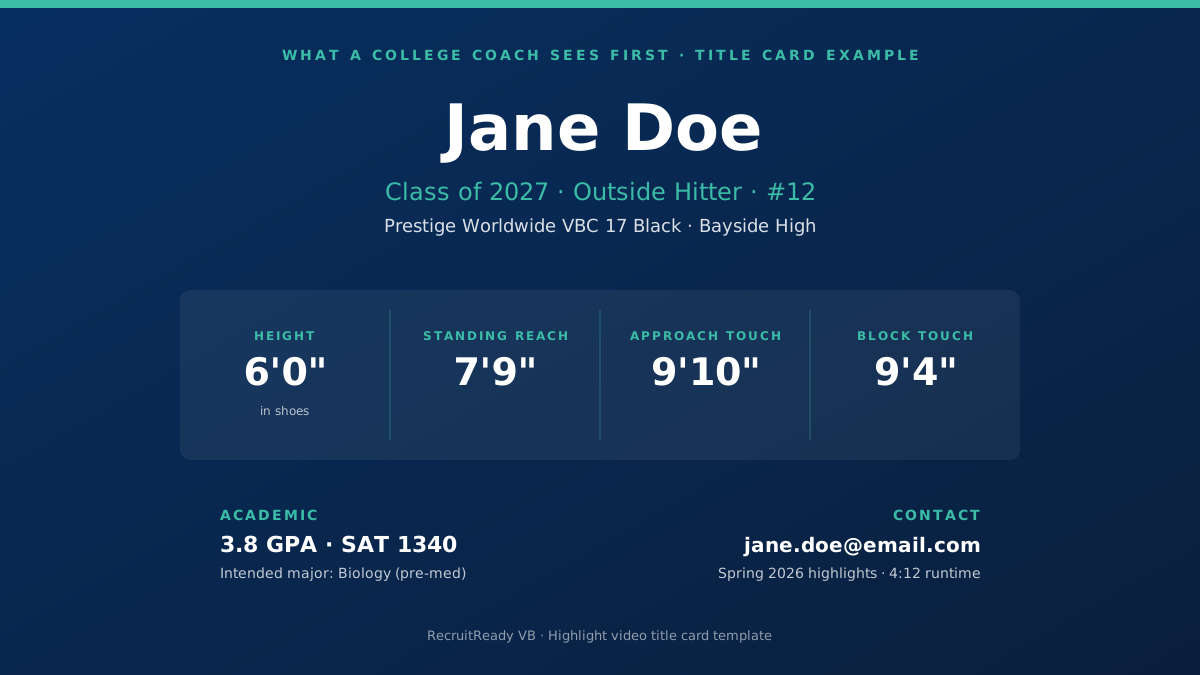
- Title card up front: name, grad year, position, height, standing reach, approach touch, block touch, club team, jersey number, GPA, test scores, contact email
- File-name clearly: “Jane Doe — 2027 OH — Spring 2026 Highlights”
Filming basics: stable tripod, mid-court or end-line angle, whole court in frame, decent lighting. You don’t need a videographer — just a phone, a tripod, and a parent in the right seat.
What Coaches Want to See in Your Highlight Video
By position: setters — location, hand quality, decision-making, defense, out-of-system sets, leadership cues. Outside / right-side hitters — approach mechanics, arm speed, shot range, blocking footwork. Liberos / DS — serve receive platform, lateral movement, defensive reads, jump serves. Middles — slide tempo, blocking footwork, reading setters across the net, transition speed.
Less obvious things coaches notice: body language between plays (a clip of your daughter clapping her teammate up after a missed serve tells a coach more than ten kills do) and recovery from mistakes (if she shanks a pass and plays an aggressive next ball, leave it in — coaches recruit players who reset, not players who pout).
What doesn’t work in a recruiting video: heavy music, slow-motion replays, fancy transitions, every-clip text overlays. Coaches turn the sound off anyway — clarity beats production effort.
Host on YouTube (unlisted is fine) and send the link in every email to college volleyball coaches. Never an attachment.
Proactively Contact College Volleyball Coaches
This is the part where families who do the work pull ahead of families who don’t. Waiting to get discovered almost never works at any level below the very top of D1. The vast majority of recruited college volleyball players — across all five divisions — send dozens of personalized emails to college coaches starting in 9th or 10th grade, and fill out the recruiting questionnaire on every target program’s website.
What goes in the first email:
- Greeting by name (head coach, then assistant coaches separately or cc’d)
- One sentence intro: name, grad year, position, club volleyball team, high school
- Measurables: height, standing reach, approach touch, block touch (or position-specific stats like passing % for DS/L)
- Academic profile: GPA, test scores if available, intended major
- Highlight video link (YouTube, unlisted)
- Upcoming tournament schedule: next 2–3 tournaments with team, court, jersey number
- One specific sentence about that college volleyball program — “I’ve been watching your offense in match film and the way your setter runs a 5-1 with two righties is exactly the system I’m built for.” Not generic.
- Close with a clear ask: would they be willing to watch her at [event] or share what they’re looking for in the [grad year] recruiting class
That specific sentence is the difference between “auto-deleted” and “I’ll go watch this kid.” Most kids don’t write it because it requires watching the team play. Watch the team play.
After the first email, settle into a steady rhythm: once a month during season, less in the off-season. Send updates with new film, new stats, new tournament dates. Don’t spam, but don’t disappear — coach lists turn over and recruiting needs shift, and the athlete in their inbox in March is the one they call in May.
If you don’t hear back after two or three emails, that’s information but not a verdict. Roster needs change.
Budgets change. Coaches change schools.
Stay polite. Stay present.
Understanding Contact Rules and Coach Responses
The NCAA contact rules in plain language: D1 and D2 college coaches cannot have direct personal communication with you until June 15 after your sophomore year. You can email them anytime before that and you should, but they can’t write back personally until that date. A verbal offer can be extended starting on that date. You can fill out a coach’s online recruiting questionnaire at any age — do this for every potential school. D3, NAIA, and NJCAA (JUCO) coaches have far more flexible rules and can often respond immediately.
Distinguish auto-responses and generic camp emails from actual recruiting interest — a mass invite to a paid summer camp is not a scholarship offer; real recruiting interest looks like a college coach reaching out by name with specifics, asking for a transcript, calling your club coach, inviting you to campus, or discussing a roster spot.
The single most common mistake I see other moms make: emails should come from the athlete, not the parent. CC the parent and keep them in the loop, but the from-line is the athlete’s, the writing voice is the athlete’s, the questions are the athlete’s. Many coaches are paying close attention to which families are athlete-driven and which are parent-driven, and they are quietly screening out the latter. (More on this and other rule specifics in our deep-dive on NCAA volleyball recruiting rules.)
📥 Halfway through and overwhelmed? Our free 7-day plan breaks the first week of recruiting work into one printable page per day.
Email draft, video plan, NCAA registration. Nothing fancy.
Just a starting point.
Keep Grades Strong and Prepare for Eligibility
Good grades are the cheapest leverage in this whole process. A strong GPA does three things at once: keeps your athlete academically eligible under NCAA and NAIA rules, opens academic aid and academic scholarships that combine with athletic scholarships, and makes her lower-risk to a college coach who has to vouch for her admission to the university — creating more opportunities at every level.
Benchmarks worth memorizing: 2.3 minimum NCAA core GPA for D1 (sliding scale with test scores); 2.2 minimum for D2; 3.0+ unlocks meaningful academic aid at D2, D3, NAIA, and JUCO; 3.5+ is where serious merit money starts stacking, especially at D3 schools.
The NCAA Eligibility Center (formerly the Clearinghouse) certifies whether your athlete is eligible to compete at D1 or D2. Register by the end of 10th or beginning of 11th grade. Send official transcripts at the end of junior year, again at graduation.
Send test scores directly from the testing service. (NCAA Eligibility Center registration.) For NAIA, register at the NAIA Eligibility Center the spring of junior year. JUCO and D3 schools don’t go through these centralized eligibility systems but have their own institutional requirements.
Boring? Yes.
Skippable? No.
Understand Volleyball Scholarships and Financial Aid
This is the section where families have the most misinformation. Athletic scholarships in women’s volleyball are equivalency, not headcount — a D1 program with 12 volleyball scholarships can split them however the coach wants (full rides, 50% rides, 25% rides, books-only). Same at D2 (8) and NAIA (8). D3 schools cannot offer athletic scholarships at all but they do offer academic merit aid, need-based financial aid, and institutional grants that often result in a net price below what a half-ride at a D1 would cost. JUCO is heavily mixed-aid — junior colleges can stack athletic scholarships, academic scholarships, and institutional aid into packages that are surprisingly generous given the sticker price.
The right number to focus on is net cost of attendance, not the athletic scholarship percentage. Net cost = tuition + fees + room + board + books + travel + everything else, minus all financial aid received.
Two scholarship offers with very different athletic percentages can land at the same net cost; two with the same athletic percentage can be wildly different.
Evaluating and Negotiating Scholarship Offers
When a scholarship offer comes in writing, ask: how many years does it renew? Most athletic scholarships are year-by-year contracts. Is it contingent on coaching staff or roster changes? What happens if the head coach leaves in year two? What does the aid cover specifically — tuition only? Room and board?
Books? Summer school? Is it in writing? A verbal offer matters in the relationship sense but isn’t binding — wait for paper, and ultimately the National Letter of Intent, before you commit.
Multiple offers create leverage. You don’t need to play coaches off each other (it backfires badly) but coaches understand the market.
And don’t optimize for marginal scholarship dollars over fit — a $3,000/year difference is not a reason to pick the school where she’ll be miserable, lose her starting spot, or hate the major. The families who pick a program for the money instead of the fit are the ones in the transfer portal by November of freshman year.
Campus Visits, Culture Fit, and Making Your Final Decision
By the time campus visits start mattering, you’ve done most of the work. Now you’re choosing.
Unofficial visits can happen at any age — the family pays. You visit campus.
You walk around and (often) meet with college coaches. NCAA rules around what coaches can do during unofficial visits get strict as your athlete moves through high school. Official visits are paid for by the school and have specific NCAA timing rules (you can start taking them later in junior year for D1/D2).
You get up to five official visits to D1/D2 schools combined — use them. Both official visits and unofficial visits are how recruits compare campus life, coaches, team culture, and academics side-by-side.
What to actually do on a visit: watch a practice if possible (you learn more in 45 minutes of practice than in any meeting with the head coach); eat with the team (coaches can fake it for a tour, teams can’t fake dinner); ask current players the real questions — what’s the hardest part of being on the team, would you pick this school again; walk the academic side, visit the major’s department. And notice the energy she has when you leave — that instinct read is real data.
Questions to ask the coaching staff directly: what does a typical week look like in-season and out-of-season; what does my role look like across four years; how do you handle injuries and academic struggles; what happens to my scholarship if I’m injured or if a new coach is hired. And — the most telling one — what do you expect from my parents during my four years here?
Fit is bigger than volleyball. Academic interests, campus size, location, weather, distance from home, social scene, food. She’s living there four years — three months a year of that is volleyball. The other nine are everything else.
Common Mistakes Families Make
If you do nothing else, avoid these six — they’re the reasons capable athletes go unrecruited.
- Starting too late. Waiting until junior year to start emailing coaches is a year behind where most rosters are getting built.
- Only targeting D1. Families who only target D1 are the ones still scrambling in May of senior year.Build across all five different divisions from day one.
- Letting the parent drive communication. Many coaches are screening for athlete-led families and quietly cutting parent-led ones.
- Generic coach emails. A copy-paste email to 40 coaches isn’t recruiting — it’s spam. One specific sentence per email is the line between deleted and replied-to.
- Outdated measurables. Your daughter grew two inches and added three inches to her approach touch since you last updated.Update.
- Skipping the NCAA Eligibility Center. Boring website, yes. Register by 10th grade anyway.
Your 7-Day Starting Checklist
You don’t need to do everything in this guide this week — you need to do something.
A printable starting plan:
- Day 1: Sit down together. Write down goals — divisions she’d be open to, regions she’d consider, intended major.
- Day 2: Pull her NCAA core course list from her high school counselor and check she’s on track.
- Day 3: Measure.Height, standing reach, approach touch, block touch, vertical.
- Day 4: Clean up her social media (coaches look) and create a simple recruiting profile with measurables, GPA, club, jersey number, video link.
- Day 5: Pick three best matches from the last 3–6 months of club film. That’s the start of the highlight video.
- Day 6: Draft the first coach email.Three paragraphs max. Specific.
- Day 7: Send it.To three real schools on your list.
That’s the first week.
📥 Want this checklist on paper? I made a printable version with every day broken out into specific tasks, plus the email template and video shot list. Tape it on the fridge: Free 7-Day Volleyball Recruiting Jumpstart.
FAQ: Getting Recruited for College Volleyball
When should my daughter start volleyball recruiting?
Most women’s prospects should begin the organized recruiting process — highlight video, personalized emails to college coaches, NCAA Eligibility Center registration, list of potential schools, recruiting questionnaires — by 9th or 10th grade.
Boys typically start a year later (10th or 11th). That said: late starters can absolutely still get recruited, especially at the D3, NAIA, and JUCO levels where rosters fill closer to senior year and college coaches have more flexibility.
If you’re starting late, start today. Sooner beats perfect.
Can a parent contact a college volleyball coach?
You can, but you shouldn’t lead the communication. College volleyball coaches are explicitly evaluating whether your athlete drives her own recruiting process — it’s one of the biggest red flags they screen for.
The right model is athlete-led, personalized emails with the parent CC’d. Parents handle logistics (travel, scheduling, signing official documents).
The athlete handles the relationship with the college coach.
Do D3 schools offer volleyball scholarships?
D3 schools cannot offer athletic scholarships under NCAA rules. They can — and often do — offer significant academic merit aid, need-based aid, and institutional grants.
For strong students, a D3 financial package can match or beat a half-ride at a D1 program on net cost of attendance. Don’t dismiss D3 because the headline number says zero athletic dollars.
What’s the average GPA for college volleyball recruits?
There’s no single number across NCAA divisions, but useful anchors: NCAA D1 minimum core GPA is 2.3 on a sliding scale with test scores for academic eligibility; competitive recruits at D2, D3, NAIA, and JUCO typically present 3.0+; meaningful academic merit aid and academic scholarships generally start to stack at 3.5+.
Higher GPAs increase your recruiting options across all five divisions, not just D3.
Is a paid recruiting service worth it for volleyball?
For most families, no — the $5,000 services don’t do anything a motivated athlete and parent can’t do themselves with a spreadsheet and three months of consistent emailing. Narrow situations exist (very busy families, athletes who need an introduction to networks they couldn’t access otherwise). We wrote a longer deep-dive on this question. Most families decide to do it themselves and put the $5K toward college.
What if my daughter is a senior and hasn’t been recruited yet?
Two things.
First — junior college is real, legitimate, and the path that re-opens doors. Many JUCO volleyball players transfer up to NCAA and NAIA programs after one or two years with better recruiting leverage than they had in high school.
Second — D3 and NAIA recruiting often runs into late spring of senior year for athletes with strong academics. Don’t write off the year.
Spend the next 90 days emailing every D3, NAIA, and JUCO program in your geographic preference range with an updated highlight video, a completed recruiting questionnaire, and a clear statement of interest.
Final Word
College volleyball recruiting is not a magic event that happens to your daughter. It’s a system of small, unglamorous, repeatable actions — research, personalized emails to college coaches, video updates, recruiting questionnaires, eligibility paperwork, campus visits — that compound over two or three years.
Most families never sit down and build the system. They do one piece (the highlight video, usually) and assume the rest will sort itself out. That’s why so many talented high school volleyball players go unrecruited and so many less-talented-but-organized ones end up signing somewhere across the five divisions.
You don’t need to spend $5,000 to do this right. You need a plan and a year. If this guide gave you the plan, the year is the easy part.
Start today
It’s the first-week version of everything above — coach list, video draft, NCAA registration, first email — broken into one printable page per day.
Download the free printable 7-Day Volleyball Recruiting Jumpstart →
P.S. — If you want the full, year-by-year version of this with all 58 printable guides, the coach email templates, and the full recruiting tracker spreadsheet, that’s our self-paced course with lifetime access and a 14-day money-back guarantee. No urgency — start with the free plan and see if it’s a fit.