

NCAA volleyball recruiting rules standardize when and how college volleyball coaches can communicate with prospective student athletes, with June 15 after sophomore year and August 1 before junior year as the most important dates.
NCAA Division I and II women’s volleyball have stricter communication timelines than Division III, NAIA, and JUCO.
Athletes can still email, complete recruiting questionnaires, make phone calls, and send a direct message before coaches can reply. Dead periods, the contact period, quiet period, evaluation period, official and unofficial visits, and academic eligibility shape every recruiting journey.
NCAA volleyball recruiting is regulated to balance competitive equity with student-athlete well-being. These volleyball recruiting rules restrict when and how college coaches can communicate with prospects, standardizing the recruiting process through strict high school timelines.
The structural breakdown of NCAA volleyball recruiting rules varies by division, timeline, and calendar type — so families must know the specific rules for the NCAA division they are targeting. This is the plain-English version. I’m not an NCAA lawyer, and these rules update annually — always check the NCAA recruiting rules page for current bylaws before making a decision.
If you’re earlier in the process, the pillar guide to how to get recruited for volleyball covers the bigger picture, and the volleyball recruiting calendar breaks down the year-by-year timing of these same recruiting rules.
Key Takeaways
- NCAA Division I and II prohibit personal communication before June 15 after sophomore year. Athletes can email, complete questionnaires, and call coaches at any time — coaches just can’t respond personally yet. D3, NAIA, and JUCO coaches have flexible rules and can respond at any age.
- Academic eligibility is half the recruiting equation. NCAA D1 requires a minimum 2.3 core GPA on the sliding scale; D2 requires 2.2. A strong GPA paired with solid test scores opens scholarship offers across more divisions and unlocks academic aid that often beats athletic aid in raw dollars.
- The four NCAA recruiting periods — contact, evaluation, quiet, and dead — control what coaches can do at any moment. Knowing which period applies prevents accidental rule violations and helps you time campus visits, calls, and emails correctly.
- Most rule violations are accidental, not intentional. Read the rules once, build the spreadsheet (Eligibility Center registered, 16 core courses tracked), and then mostly forget them — circling back only when a specific moment requires you to check.
The Three Bodies: NCAA, NAIA, and NJCAA
Most families assume “college volleyball recruiting rules” means NCAA. There are actually three separate governing bodies in U.S. college volleyball, each with its own rulebook:
| Body | Programs (women’s VB) | Recruiting rules character |
|---|---|---|
| NCAA (Division I, II, III) | ~1,060 total | Most detailed; specific contact dates, recruiting periods, eligibility center, sliding-scale GPA |
| NAIA | ~210 | More flexible communication rules; separate Eligibility Center |
| NJCAA (JUCO) | ~280 | Most relaxed; no D1/D2-style period restrictions |
This guide focuses on NCAA volleyball recruiting rules since they’re the most asked about and the most restrictive.
NAIA and NJCAA rules are covered briefly where they diverge meaningfully. Each body publishes its own annual recruiting calendar and eligibility process — confirm with each program’s compliance office.
NCAA Contact Rules by Grade Level
The NCAA recruiting calendar is divided into specific periods and grade-level rules that govern when college coaches can communicate with prospective student athletes.
Before sophomore year: NCAA Division I and II coaches cannot directly communicate with recruits or their families until June 15 after the recruit’s sophomore year. Before that date, coaches can watch the athlete compete, talk to her high school or club coaches, and send camp brochures, camp invites, recruiting questionnaires, non athletic publications, and other NCAA materials at any time — but they cannot make phone calls, send instant messages, send a direct message, or have face to face contact.
Time private correspondence is restricted. NAIA, NCAA Division III, and NJCAA have fewer restrictions and can communicate at any age.
Sophomore year — the most important date. D1 coaches cannot initiate direct recruiting contact before June 15 after a recruit’s sophomore year, and athletes can reach out anytime. NCAA Division 1 volleyball coaches can start contacting recruits on June 15 after the athlete’s sophomore year, which includes extending verbal scholarship offers and almost all forms of communication such as emails, instant messages, direct communication, and phone calls.
NCAA Division 2 volleyball coaches can contact recruits by any means starting June 15 after the recruit’s sophomore year, with no restrictions on communication thereafter. Recruits can communicate with college coaches at any time, including sending emails, texts, and direct messages, regardless of NCAA division restrictions on coaches’ responses.
Junior year in person and beyond. After June 15, the rules open. For NCAA Division I programs, official and unofficial visits cannot happen until August 1 before the recruit’s junior year, and recruits can only go on five official visits across all Division I sports combined (only one official visit to the same institution).
Senior year is decisions and signing — National Signing Day for volleyball is November (early signing period) and April (late signing period). The National Letter of Intent (NLI) is the first legally binding document; verbal commits are not.
For deeper grade-by-grade coverage of the contact period, evaluation period, quiet period, and dead period calendar, see the volleyball recruiting calendar.
D1 vs D2 vs D3 Volleyball Recruiting Rules
Different NCAA divisions follow different rules. The single biggest mistake families make is reading one set and assuming it applies across division levels.
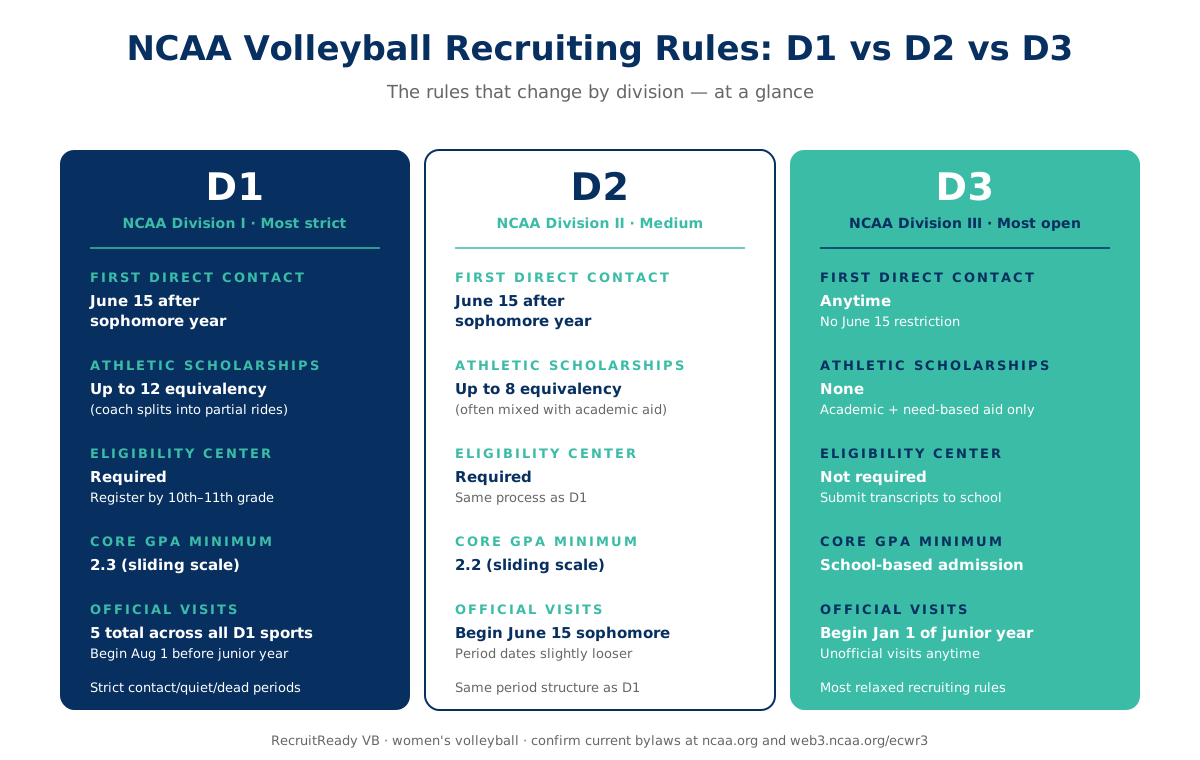
NCAA Division I rules are the strictest.
Defined contact, evaluation, quiet, and dead periods govern when face to face contact and off campus contact is allowed. Recruits must register with the NCAA Eligibility Center and meet the academic sliding scale (2.3 minimum core GPA). Division I women’s programs now also manage a maximum roster limit of 18 players, which affects scholarships and roster conversations.
NCAA Division II rules are similar to D1 with slightly different period dates and a 2.2 minimum core GPA. NCAA Division II programs allow unofficial visits at any time and official visits after June 15 of the recruit’s sophomore year — so a sophomore year official visit can happen earlier in D2 than D1.
NCAA Division 3 volleyball has the most relaxed recruiting rules, allowing coaches to communicate with recruits at any time, although there are restrictions on official visits and off-campus contact. For NCAA Division III programs, unofficial visits can happen at any time, while official visits can occur after January 1 of the recruit’s junior year. D3 schools cannot offer athletic scholarships — they can offer academic merit aid, need-based financial aid, and institutional grants.
NAIA and NJCAA offer more flexible paths than NCAA different divisions. NAIA programs allow both unofficial and official visits to occur at any time, providing more flexibility for recruits compared to NCAA divisions.
NAIA coaches can generally contact recruits by text, email, call, or social media at any time.
NCAA Recruiting Periods Explained
The NCAA volleyball recruiting calendar specifies different periods such as contact, evaluation, quiet, and dead periods, which dictate when coaches can interact with recruits and under what circumstances.
| Period | What coaches CAN do | What coaches CAN’T do |
|---|---|---|
| Contact period | Face to face contact off campus; on college campus meetings; phone, email, text, direct message, instant messages, social media | — (most permissive) |
| Evaluation period | Watch an athlete compete in person or practice off campus; phone, email, text | No face-to-face contact off campus; coaches may attend only one event per day |
| Quiet period | Phone, email, text, direct message, social media; campus visits only | No face to face contact off campus |
| Dead period | Phone, email, text, social media only | No face to face contact anywhere; no unofficial and official visits |
During the dead period, NCAA Division 1 coaches are prohibited from having any in-person contact with recruits, but they can still communicate through electronic means such as phone calls and emails. During the evaluation period, college coaches can watch recruits compete in person and may communicate with them about recruiting, but they cannot have face-to-face contact during the quiet period.
Recruiting materials, such as camp invites and questionnaires, can be sent at any time, but personalized communication is restricted by division. The NCAA publishes the contact, evaluation, quiet, and dead period calendar annually — confirm against the current NCAA recruiting calendar before booking travel.
NCAA Eligibility Center and Academic Requirements
The NCAA Eligibility Center certifies whether your athlete is eligible to compete at Division I or Division II level.
Boring website, yes. Register by 10th grade anyway.
Registration is required to receive an athletic scholarship, sign a National Letter of Intent, or take an official visit. Most families register at the end of 10th grade or beginning of 11th grade.
NCAA academic eligibility for D1 and D2 hinges on three numbers: 16 NCAA-approved core courses, a minimum core GPA, and a test score (test scores are once again required under current 2026 rules). Division I uses a 2.3 minimum core GPA on a sliding scale; Division II uses 2.2.
Division III does not use a sliding scale — admission and aid are determined institutionally. The 10/7 rule for D1 requires 10 of the 16 cores completed by the start of senior year, with 7 of those in English, math, or science.
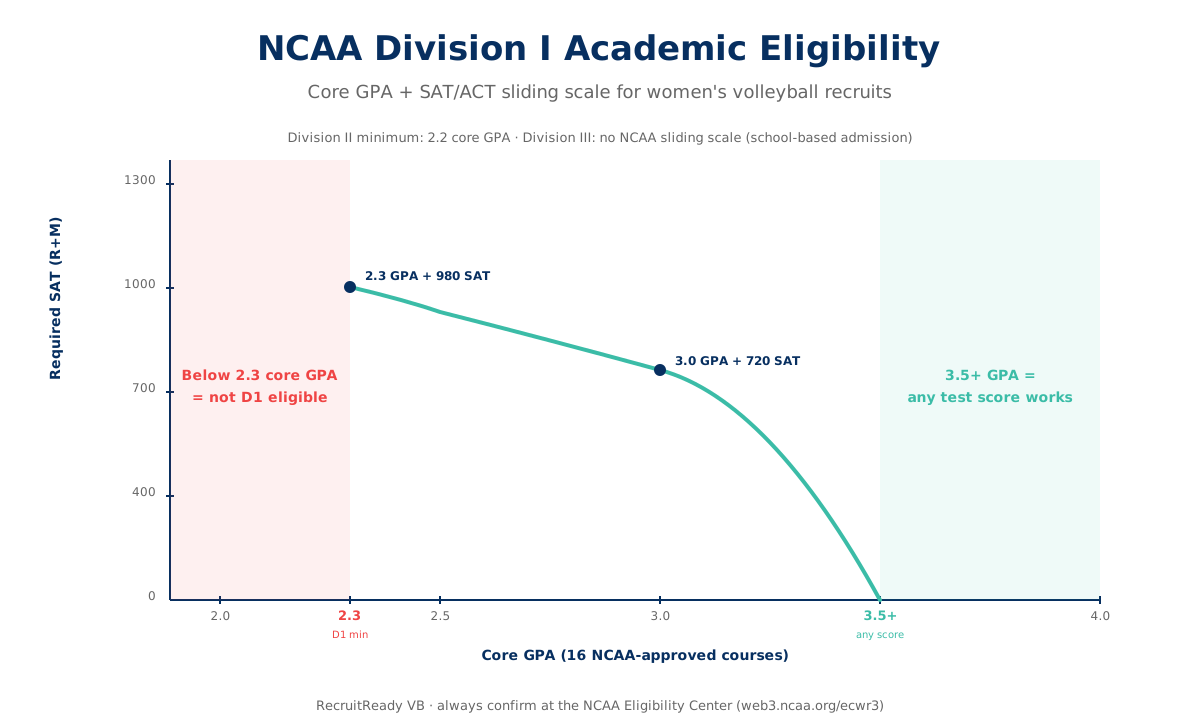
| Core GPA | SAT (R+M) | ACT sum |
|---|---|---|
| 3.5+ | Any | Any |
| 3.0 | 720 | 59 |
| 2.5 | 900 | 75 |
| 2.3 (D1 minimum) | 980 | 86 |
| Below 2.3 | Not D1 eligible | Not D1 eligible |
Common registration rejections: non-approved core courses (pull your school’s NCAA Course List from the Eligibility Center before scheduling junior and senior year classes), late transcript submission, test scores sent through the high school instead of the testing service, and incomplete amateurism questionnaires.
📥 Need help with registration? Our free 7-Day Volleyball Recruiting Jumpstart walks through the Eligibility Center registration step-by-step.
Tape it on the fridge.
Volleyball Performance Benchmarks Coaches Care About
NCAA rules tell you when coaches may contact you; performance benchmarks tell them where you fit. College volleyball coaches look at height, standing reach, block touch, approach jump, attack touch, hitting percentage, serve-receive, and passing efficiency. Verified combine data helps programs compare athletes across division levels.
College coaches begin evaluating recruits as early as 13 to 14 years old for women’s NCAA Division I and high-level Division II programs, while men’s NCAA Division I and II programs typically start around 15 to 16 years old. Evaluation of recruits is an ongoing process that includes assessing athleticism, physicality, personality, character, and leadership skills, and can occur through live events or online videos.
For most NAIA, Division III, and NJCAA programs, coaches typically start evaluating recruits at ages 16 or 17, often after the recruit has taken their SAT or ACT exams. Top recruits in D1 and D2 may receive a verbal scholarship conversation soon after June 15, while formal written agreements come later.
Training to Jump Higher
To jump higher, train strength, power, and landing mechanics consistently.
Useful work includes squats, lunges, hip hinges, box jumps, depth jumps, lateral ski jumps, calf raises, core work, and mobility drills. Track approach touch and block touch every few months; sharing verified improvement with college volleyball coaches strengthens recruiting updates, especially for front-row volleyball players.
Position-Specific Considerations
The rules are the same by position, but evaluation is not.
Outside hitters need arm speed, six-rotation skill, and passing. Right side hitters must block elite pins and attack from the right. Middle blockers need height, quickness, timing, and reach. Setters and liberos are judged more on leadership, decision-making, lateral quickness, range, and consistency.
Average vertical jump for college volleyball players is often around 18–20 inches, with outside hitters, right side hitters, and middle blockers needing higher explosive numbers.
Common Rule Violations Families Make Accidentally
Most NCAA recruiting rule violations are accidental. A short list to avoid:
- Posting publicly about a verbal offer during a dead period. A social media post tagging a coach can trigger a compliance review.Wait until the program or recruiting director clears it.
- Off-campus face to face contact during a quiet period. Bumping into the coach at a tournament is fine; sitting down with them off campus is not.
- Using a recruiting service that contacts coaches outside the allowed window. You’re responsible for what services do on your behalf. Read the contract.
- Missing core course documentation. Mid-year transcripts dropped or a school’s NCAA Course List not updated means courses she took don’t count toward the 16.
- Late Eligibility Center registration. Registering in spring of senior year leaves no time to fix non-approved courses, missing transcripts, or amateurism flags.
- Accepting impermissible benefits. Free meals beyond the per-visit limit, free apparel, free transportation outside official visit rules — all can affect amateurism status.
Practical Checklist: Staying Compliant and Standing Out

A simple plan to actively start communicating with college coaches while staying compliant:
- Map freshman, sophomore year, junior year, and senior year against June 15, August 1, January 1, and signing dates
- Build an athlete profile with position, height, weight, GPA, video, standing reach, vertical jump, test scores, and tournament schedule
- Complete recruiting questionnaires on every target program’s site, then follow with personalized emails to express interest
- Ask every recruiting director or coach about roster openings, admissions, scholarships, and camp options
- Monitor NCAA.org and each school’s compliance pages every year — rules change annually
Frequently Asked Questions
What GPA do I need for D1 volleyball?
NCAA Division I requires a minimum 2.3 core GPA on the sliding scale, paired with a corresponding SAT (980 R+M) or ACT (86 sum) score.
A 3.5+ core GPA qualifies regardless of test score. Most competitive D1 volleyball recruits present a 3.5+ core GPA. Many present 3.8+.
Higher GPAs unlock more academic aid stacked with athletic scholarships.
Can a coach text my daughter before June 15?
NCAA Division I and II coaches cannot text, call, email back personally, or send a direct message to recruits before June 15 after the recruit’s sophomore year of high school. Coaches at NAIA, NCAA Division III, and NJCAA programs have far more flexible rules and can text recruits at any age.
Recruits can email D1 and D2 coaches at any time — the coach just can’t reply personally yet.
What’s the difference between D1, D2, and D3 volleyball recruiting rules?
NCAA Division I has the strictest rules: June 15 contact rule, NCAA Eligibility Center required, 2.3 minimum core GPA, defined recruiting periods, and 5 total official visits across all D1 sports combined. Division II is similar but with a 2.2 minimum GPA and slightly looser period dates.
Division III has the most relaxed recruiting rules — communication anytime, no athletic scholarships, official visits start January 1 of junior year.
Do D3 volleyball recruits need the NCAA Eligibility Center?
No. NCAA Division III does not require Eligibility Center registration.
Each D3 institution handles admission and academic eligibility internally. D3 recruits submit transcripts directly to each college as part of the regular admissions process.
This is a meaningful workflow difference — don’t register at the Eligibility Center if D3 is your entire target list.
What happens if you miss the NCAA Eligibility Center deadline?
Technically there’s no single deadline, but practically the athlete must be fully certified before her first day of NCAA competition. Common consequences of late registration: senior-year recruiting offers stalled while the certification clears, missed test-score windows, non-approved core courses discovered too late to retake, and (worst case) being declared a partial qualifier or non-qualifier as a freshman.
Register at the end of 10th or start of 11th grade.
Are NCAA recruiting rules the same for all sports?
No. NCAA recruiting rules vary by sport and division.
Women’s volleyball has its own contact-date calendar (June 15 sophomore year for D1/D2). Other sports — softball, soccer, basketball — each have their own contact dates and period rules.
Beach volleyball has rules similar to indoor volleyball but with slight differences around July and the championship. Always look up the sport-specific NCAA recruiting calendar.
Final Word
NCAA volleyball recruiting rules are guardrails, not a quiz. The families who handle them best read the rules once, build the spreadsheet (Eligibility Center registered, 16 core courses tracked, GPA and test scores on file), and then mostly forget about them — circling back when a specific moment requires it.
The rules are detailed but they’re also the same for everyone. The advantage goes to families who simply read and follow them while everyone else assumes someone else is handling it.
Start today
it includes the NCAA Eligibility Center registration walkthrough plus the first week of recruiting actions, one printable page per day.
Download the free printable 7-Day Volleyball Recruiting Jumpstart →
P.S. — The full course at recruitreadyvb.com goes deeper on every rule above: a 58-PDF library, the full recruiting tracker spreadsheet, and the coach email templates. lifetime access and a 14-day money-back guarantee.